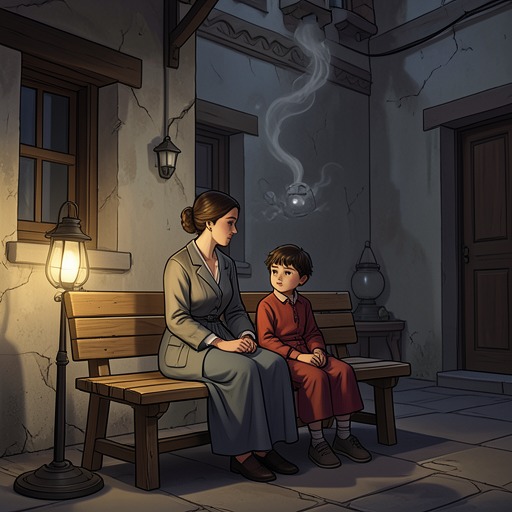
Pedro Páramo and Eduviges Dyada: A Wedding-Night Encounter
Pedro PáramoPedro Páramo and Eduviges Dyada’s wedding-night encounter grows out of a close friendship between Eduviges and Dolores Preciado: when Dolores cannot bring herself to share her wedding night with Pedro, she asks Eduviges to go in her place. Eduviges accepts not only as a favor but because she, too, desires Pedro. The night produces an intimacy between them, but not the encounter Dolores had feared or expected; Eduviges later returns to her friend with the outcome still uncertain. Years afterward, Eduviges’s account to Dolores’s son gives the episode a second life, linking sexual substitution, friendship, and the unresolved question of whose child he might have been.
Friendship and the Wedding-Night Crisis
Eduviges recounts the episode to Juan Preciado, presenting herself first as Dolores’s intimate friend. The two women had been very young, and Dolores had only just married when the incident occurred. Their closeness was strong enough that they had once promised to die together, each accompanying the other on the journey beyond life if either met difficulties there. That promise makes the wedding-night request part of a longstanding bond, not an isolated arrangement between acquaintances.
The immediate crisis comes from Inocencio Osorio, who had warned Dolores that the moon was unfavorable and that she must not unite with a man that night. Dolores arrives distressed, telling Eduviges that she cannot sleep with Pedro on their wedding night. Eduviges tries to persuade her not to believe Osorio, whom she regards as a fraud and seducer. Dolores nevertheless insists that Eduviges take her place, promising to repay the favor many times over. The request puts friendship under unusual pressure: Dolores asks Eduviges to cross into the marriage bed for her, while Eduviges must decide whether loyalty means refusing or complying.
The Substitution and the Encounter
Eduviges explains that the resemblance between them made the substitution possible in darkness. She was younger than Dolores and her skin was somewhat less dark, but she believed such differences would not be noticed. She also recalls Dolores’s humble gaze and beautiful eyes, which could persuade her. In this telling, the substitution depends on both practical concealment and the intimate force of Dolores’s appeal.
Eduviges admits that she had an additional reason to accept: she liked Pedro herself. She went to him willingly and says she slept with him with pleasure. Yet the encounter did not unfold as a conventional wedding night. Pedro was exhausted by the previous day’s feasting; he spent the night snoring, and the only physical contact Eduviges describes is that their legs became entwined. Her account therefore holds desire and anticlimax together. She wanted Pedro, but the night offered no clear evidence that he recognized her as Dolores, or that the substitution achieved what Dolores had asked of her.
Before dawn, Eduviges got up and went to Dolores. She told her that she could go now, since it was another day. When Dolores asked what Pedro had done to Eduviges, the answer was that she did not yet know. The exchange leaves the night’s meaning deliberately unresolved: Eduviges has been with Pedro, but his exhausted sleep prevents her from reporting a definite sexual response. Her next-morning message returns the decision to Dolores rather than claiming the marriage night as her own.
The Son and the Unsettled Aftermath
Eduviges connects that night to Juan Preciado’s birth the following year, then draws a careful distinction: Juan was not her son, though matters nearly turned out that way. The account does not explain precisely what she means by that near possibility. It does, however, make the substitution more than a brief favor in retrospect. The encounter enters the imagined history of Juan’s parentage, while Eduviges’s statement preserves the boundary between what happened and what might have happened.
When speaking to Juan, Eduviges says that Dolores was beautiful and tender, someone it was a pleasure to love, and that she had loved her greatly. She also tells him that Dolores’s son ought to have been hers, adding that she will explain why later. The remark draws the episode into a larger, unresolved attachment: Eduviges’s bond with Dolores survives as affection, grief, and a claim she cannot fully clarify in this conversation. Her promise to catch up with Dolores on one of the paths of eternity echoes their old promise to die together, giving their friendship a continuing presence beyond the wedding-night story.
Retelling and Narrative Effect
The encounter reaches Juan through Eduviges’s spoken recollection, years after the event, rather than through an independently narrated scene. The episode is therefore shaped by her own account of her motives: she acted at Dolores’s request, but she also acknowledges her attraction to Pedro. Those two explanations coexist, preventing the act from being reduced either to pure self-sacrifice or to a simple attempt to take Dolores’s place.
Juan’s response marks the cost of hearing this history from a dead woman who speaks to him as though he were her son. At first he thinks Eduviges is mad; then he stops believing anything at all and describes himself as carried away, his body slack and pliable. The disclosure thus unsettles more than his understanding of his mother’s marriage. Eduviges’s intimate memory blurs the lines between substitute and friend, possible mother and actual mother, past event and present encounter. What remains unresolved is central to the relation: Eduviges was Pedro’s partner for a night, Dolores’s devoted friend, and a woman who later tells Juan that he might nearly have been hers.